Tuesday, August 31, 2010

Our CSA experience - third box


In our third box from the CSA farm we got:
- beets
- our first tomatoes!
- fresh basil
- chard
- red cabbage
- salad
- walla walla onions
- kohlrabi
- eggs
- 1 zucchini
I tried roasting the beets, as many people had told me that was the best way to have them, and even though I have to say they were good, it seemed like way too much work and heat for a few beets, maybe if I had roasted them with something else it would have been different.
With the chard I made an awesome pie, I took the recipe from Martha Stewart's website and I have to say it was really tasty and pretty to look at. Definitely a good way to prepare any leafy vegetable, a great variation would probably be with spinach and ricotta, like we do in Italy.

Our CSA experience - visit to the farm

Freedom Organix - vegetable patch
A couple of weeks ago we visited our CSA farm, FreedomOrganix. The farm is located right out of Harvard, so for us it is about a 40 minutes drive from home. Harvard is still a very rural town where farming is the biggest source of income. Judging by the look of the downtown it probably saw better days and the recession must be hitting it pretty hard. It is also known for its "Milk days" a festival that honors the fact that dairy farming is big in the area. In fact we passed by a Dean's milk plant, but we didn't see too many cows around, a testimony to the fact that the cows are probably mostly kept indoors in big plant-like facilities. What we do see is field after field of corn and soy, each one with their little sign specifying that those fields are planted with such and such genetically modified kind of seed whose patent therefore belongs to such and such firm. I used not to notice those, now I see them everywhere and it is kind of scary to think of what they mean.
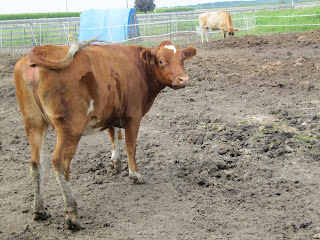
When we got to the farm we were greeted by a menacing dog, and the farmer, Cindy Nawiesniak, yelling at us to get back in the car until she locked the dog. It was kind of a scary beginning, but that's how farm dogs are, after all they have to defend the cattle and animals from intruders. Things got better right away though, Cindy was very friendly and talkative and enjoyed showing us around. We met the chickens that make our eggs every week and some other chickens that she "boards" for some restaurant. I have to admit these last ones didn't look particularly good, as they were losing their feathers, but she said it was normal. The chickens live in a pen that is moved around periodically. Around the pen there is an electrified fence to keep predators away.
 Apparently that doesn't deter some owl who keeps attacking and decapitating the chickens through the pen, and I thought owls only ate mice and snakes! She also has cows, and she sells the meat by the quarter, a little too much for our small family, but who knows, maybe in the future it would be an interesting way to buy meat and just freeze it and keep it, it would definitely be cheaper than buying it at the farmers market every week. She had a lot of calves who were very cute and she seemed very fond of them too. We saw all our future vegetables, including lots of potatoes and tomatoes and a lot of fennel apparently, and we found out that for some reason she is not very fond of zucchini (too bad because we love zucchini!)I think the reason is that it invades too much of the space of other plants. Our son was probably too young to appreciate any of this, although he enjoyed seeing the chickens, but I think it is going to be great to bring him there every year and make him realize that that is where his food ( or most of it) comes from.
Cindy talked to us about how she grew up in her grandparents farm, and how she felt the connection, how she had milk right out of a cow and ate fruit right off a tree branch and found unbelievable that kids nowadays don't make this connection with  the source of their food anymore. I think adults don't make that connection either, many of my friends will admit candidly that they don't want to know where their food is from, that they don't want to remember that it was once an animal, or something covered in dirt. People like prepackaged, sterile, unidentifiable foods, and that way get fooled by the industrial food system that sells them corn shaped into a hundred different things, and they are happy with it. Maybe if we knew what a chicken really looks like we would realize that a chicken breast CAN'T be that big, or if we knew what a fresh tomato tastes like we wouldn't buy those artificially ripened tasteless things they call tomatoes in the store.

Saturday, August 7, 2010

Nature's Cornucopia in Mchenry,IL

I visited this store because of the large sign on the window that says "health food store" and because many websites related to organic products would direct me to it as a place that would be stocked with a variety of organic products. I was initially a little disappointed because most of the store seems to be actually dedicated to vitamins, herbs and other forms of holistic cures, which is something I am not very interested about. I wish they wouldn't mix the vitamin store with the food store, I think that taking so many integrators sort of contrasts with the idea of eating healthy and getting the best out of food, a sort of shortcut  that does not replace at all a varied and rich diet. There are contrasting opinions on the effectiveness of taking supplements, I don't think it is necessarily bad, but at the same time I don't appreciate how some of these products are advertised as some sort of "cure-all" for your problems. They have for example a nutrition consultant on site that for 95$ will give you a consult and prescribe the supplements that you need. It seems to me that a nutritionist should be recommending you a better diet first, supplements last. And the fact that he would recommend you the supplements in a store like this seems to me more like a way of selling more than a real doctor consultation.
 At the back of the store I found more food products: they have a large selection of gluten-free foods, including quinoa and buckwheat cereals, that I decided to try. I am sure I will also try some of their gluten-free flours once I get the bread machine. They have some frozen products, some of them gluten-free, others organic, including organic meats. I bought the chicken sausages, but they come from the the New York state, so they are definitely not a local product. They have slices of american cheese from the brand Horizon Organic, and another couple of cheeses that unfortunately are not organic. They also have some unusual finds like goat milk yogurt and many things from tofu dedicated to vegan eaters. The prices were quite steep, as expected, and I think I will only be going back for some of the most unusual products that I know I would not find elsewhere. I definitely did not like the vibe of the place, that seemed like a little bit of a mash of everything related to the adjectives "natural" and "healthy" that are so liberally and so mistakenly spread around to market so many different kinds of things.

Friday, August 6, 2010

Product Review: Organic Chicken from R-Family farm

Normally sized Chicken Breasts from R-family farm
Last week we bought a whole cut-up chicken from R-Family farm at the Woodstock Farmers'market. They had just killed them the day before the market, so you definitely cannot go any fresher than that! It has to be said that at 4.50 a pound it is much more expensive than any chicken you will buy at the store, but we are trying to reduce the amount of meat we eat per week, plus I could use the chicken to prepare three different dishes, thus making it last a little longer. Looking to other prices online it seems like it wasn't even that expensive for organic chicken, as I have seen some websites listing 6-8 dollars a pound.
I oven roasted the breasts, the wings and the legs, simply adding salt and pepper to them. Since I left the skin on while cooking I didn't even have to add any oil, but just a little bit of broth at the bottom of the pan as they were drying out a little too much. One thing I have noticed immediately is that usually chicken releases a lot of water and fat while roasting while this didn't have almost any. The result was crispy and full of flavor, which is what struck us the most: we are used to a pretty tasteless chicken, except from the taste of the herbs and spices that we add to it, while this chicken had a taste of its own. The meat was firm and juicy and did not fall off the bone as easily as a store bought chicken. 
With the back and the neck of the chicken I made a chicken broth that we ate the following day with tortellini, while I used the meat, together with some leftover breast, to make baby food for my son. We still have the chicken liver and I plan to make with it an Italian specialty, Risotto ai Fegatini,  that I hope my husband, the picky american, will accept to eat. I think that using all the parts of the animals is a way to respect the fact that we took their life, at least we are making the most out of it and not just discarding it and throwing it away.
I am posting a pictureof the chicken breasts because I wanted to show how much smaller they were in size compared to the gigantic breasts we find at the supermarket, but unfortunately I didn't put anything to the side to compare them with, so it is hard to tell. I will have to take a better picture next time.

Do Journalists Know What Organic Really Means? ABC7 news

Today I was watching ABC7 and they were doing a section on food with Steve Dolinsky called the Hungry Hound that reviews local restaurants and food of the Chicago area. As they were closing in, Steve Dolinsky mentioned something about organic pork being used more and more in Chicago restaurants, and one of the hosts of the program ( I did not catch her name unfortunately ) thought it was very funny to comment " Organic Pork? isn't that an oxymoron?" The other host was quick to reply that it is important what the pig had been fed, but the segment was ending so they quickly moved to a new topic. I think it is infuriating how people keep thinking that organic simply means healthier. Researching more into ABC7 website I found another video of a segment called Organic Answers, that is dedicated to make people understand organics. Needless to say they open up by saying "many people have been buying organic for years for health reasons". In the segment they go on explaining how after all certain fruits and vegetable can safely be bought even if not organic because of a thicker skin that is more resistant to pesticides. 
As much as I appreciate the fact that the organic market is getting more attention in the media, a trend that reflect a growing interest from the consumers, I really think they should inform themselves a little better as to what organic really means. I have been through this over and over on my website, but it is not just a matter of what is healthier for me, it is also a matter of what is better for the environment, the economy, the people and the animals involved. As long as organic will be associated with healthy only, there will always be people able to say that after all an organic vegetable has the same nutritional value of a non-organic one, which even if it were true, it is still not the point.

The Bread Quest - Second Attempt


My lovely husband last week decided to try making bread again and this time he did a Ciabatta bread! He took the recipe from Epicurious but substituted part of the flour with whole wheat upon my request. Probably for this reason the bread didn't rise as much as it should have, but it was still pretty good! Kudos to my husband! Right away out of the oven it seemed a little to yeasty, but I have to say that when it cooled off it tasted just perfect. The crust wasn't as crunchy as you would find it in Italy, but it was still good enough. Our son loved it and I have to say that there is a certain satisfaction in seeing your son eating something you have made from scratch and you know exactly what ingredients you put in it. The only downside is that the whole process took 24 hours ( he left the first part of the dough rest overnight) and even though the result was so good, it is still very laborious to make more often than once a week, so I finally convinced him to get a bread machine. It is the Westbend 41300 Hi-Rise Electronic Dual-blade Breadmaker ( what a big name for an appliance) and we are looking forward to try it once we finally get it. I am hoping to make bread at least twice a week and to try some recipes without or with a lower amount of gluten.


As for buying bread, the supermarket does not carry any brand that is organic. Sara Lee apparently tried to cash in on the growing organic market by launching a brand called EarthGrains. This brand ( sold at my local supermarket ) advertised the use of at least 20% of Eco-grains. Apparently these grains are grown in Idaho through a technique called precision farming that should reduce the erosion of the soil and the use of pesticides and fertilizer. As much as good an attempt this is, it really looks like a way to look more green in order to sell to a different market of people, and it seems like Sara Lee already got in trouble with an organic growers' association for claiming on its website that Eco-grains are better than organic. According to an article I found on the Star-Telegraph Sara Lee was forced to remove the comparisons with organic from their website, in which they claimed that organic crops still impoverish the soil and destroy undeveloped land.On the other hand other experts say that these claims would be true if the Eco-grain were cultivated with a no-till technology, which eliminates the erosion problem, but they aren't.  The  organic association, called Cornucopia, posted on their website a fact sheet comparing Eco-grain with organic grains, but they do not mention the tilling problem at all. To me that of Sara Lee looks just like another marketing strategy, and I will be happy to make my own bread instead. For now we already have so much flour in the house that we have decided not to buy anymore until we finished what we have. Then the quest for the perfect sustainable flour will start, and who knows where that will take us.


Our CSA experience - second box


Here is week 2 of our CSA experience with Freedomorganix:

- 12 eggs
- 1 melon ( not sure what it is called, it is orange inside but it is not a Cantaloupe)
- 1 small pale yellow squash
- 1 large onion
- 1 bunch of fresh onion
- 1 kohlrabi
- 1 big bag of salad
- 1 big bag of arugula
- 2 jalapeno peppers

Last week the quantity was pretty good for us in the end. With the arugula, that was particularly pungent and flavorful, I made pesto and also a sort of pasta Carbonara with eggs, Parmesan cheese, German prosciutto and arugula. I did not include the recipe because the prosciutto and the cheese were not organic, so they really did not fit the requirements of the quest. I suspect this week I am going to have to buy some extra vegetables, like some tomatoes for example. I finally found a good way to prepare the kohlrabi: I diced it in bite-size pieces and then boiled it. Then I seasoned it with light mayo, salt, pepper and fresh parsley, pretty much like a potato salad. my husband loved it. The mayo was not organic either, I wonder if you could even find an organic one. At the end of the week I had some salad leftover and 3 eggs so I made a Frittata with it. Basically I just cooked an onion and tossed the leftover salad and arugula in it then added the 3 eggs that I had beaten lightly with salt, pepper and fresh parsley. I let it cook covered until it looked done. Frittata is a great way to use any leftover quantity of vegetables and add some protein to your meal through the eggs, for a lighter version you could also use only the white of some of the eggs. This week I don't know what I will do with the Jalapenos, since I am not a big fan of spicy foods, I think I will use them with some of the canned beans that we have and make a sort of chili-like preparation.